RESEARCH
Representation co-design.
Designing spatial representations together with algorithms and hardware to reduce the data robots store, process, and exchange.
Why data movement matters
Moving data can cost more energy than arithmetic.
1× = 0.1 pJ integer addition. k = thousand; M = million; B = billion.
1× = 0.1 pJ integer addition.k = thousand; M = million; B = billion.
Scroll to follow the three stages, or choose a stage.
Arithmetic within a robot
- Energy: 0.1 pJRelative energy compared with 0.1 pJ integer addition: 1×
- Energy: 0.9 pJRelative energy compared with 0.1 pJ integer addition: 9×
- Energy: 3.7 pJRelative energy compared with 0.1 pJ integer addition: 37×
Data movement within a robot
- Energy: ≈5 pJRelative energy compared with 0.1 pJ integer addition: ≈50×
- Energy: ≈10 pJRelative energy compared with 0.1 pJ integer addition: ≈100×
- Energy: ≈50 pJRelative energy compared with 0.1 pJ integer addition: ≈500×
- Energy: ≈0.65–1.4 nJRelative energy compared with 0.1 pJ integer addition: ≈6,500–14,000×
Data movement across robots
- Energy: ≈80 nJRelative energy compared with 0.1 pJ integer addition: ≈800,000×
- Energy: ≥2.7 μJRelative energy compared with 0.1 pJ integer addition: ≥27 million×
- Energy: ≈17–120 μJRelative energy compared with 0.1 pJ integer addition: ≈170 million–1.2 billion×
- Energy: <32 to ≈320 μJRelative energy compared with 0.1 pJ integer addition: <320 million to ≈3.2 billion×
Sources and conditions
In these estimates, reading a 32-bit word from an 8 KB SRAM uses about 50× the energy of one 32-bit integer addition. (Horowitz, 2014)
Arithmetic values describe one operation on 32-bit operands. Data-movement values describe transferring one 32-bit word. The reference estimates span 2009–2014 and different technologies and operating conditions.
Horowitz’s Figure 1.1.9 labels the arithmetic values as rough estimates at 45 nm and 0.9 V. Lighter spans show reported ranges. Arrowheads mark one-sided bounds.
BLE has no quoted upper endpoint; LTE’s low-side threshold is below 32 μJ. Scroll stages reveal bars cumulatively without rescaling the axis. Each category’s labels and bars appear together. Each narrow-screen row keeps its operation, energy, fixed-scale bar, and comparison factor visible together.
- Horowitz (2014) · Computing’s Energy Problem (and What We Can Do About It)
Figure 1.1.9 gives rough arithmetic energy costs at 45 nm and 0.9 V. For 32-bit operands, it lists 0.1 pJ for integer addition, 0.9 pJ for floating-point addition, and 3.7 pJ for floating-point multiplication. These are per-operation estimates. Its 64-bit cache-access estimates are 10 pJ for 8 KB, 20 pJ for 32 KB, and 100 pJ for 1 MB. The chart divides those cache values by two to give its normalized 32-bit-word basis.
- Keckler et al. (2011) · GPUs and the Future of Parallel Computing
DRAM energy context. The plotted range combines the reference estimates from this study and Horowitz (2014); technology and operating conditions differ.
- Chandrakasan et al. (2009) · Low-Power Impulse UWB Architectures and Circuits
The illustrated receiver consumes 2.5 nJ/bit at 0.65 V above 10 kb/s: 80 nJ for 32 bits.
- Siekkinen et al. (2012) · How Low Energy Is Bluetooth Low Energy?
BLE energy utility depends on payload and connection-event configuration. The plotted value is a lower bound, not a fixed cost for every transfer.
- Xiao et al. (2010) · Practical Power Modeling of Data Transmission over 802.11g
Wi-Fi power-saving examples at 16–256 KB/s. Throughput and traffic burstiness affect energy per word.
- Huang et al. (2012) · A Close Examination of Performance and Power Characteristics of 4G LTE Networks
Bulk-transfer uplink energy decreases from about 10 μJ/bit to below 1 μJ/bit as the transfer grows. These data-transfer measurements exclude promotion and tail energy.
THE CENTRAL QUESTION
What should a robot represent, retain, and communicate to achieve energy-efficient spatial intelligence?
Spatial intelligence is the embodied AI by which a robot perceives, localizes, and maps its 3D environment. The robot uses that information to act and collaborate.
Spatial representations determine the structure and volume of data that robots store, process, and exchange. Algorithms and hardware can reduce data movement toward the minimum required by a given representation. Redesigning the representation can lower that minimum by reducing the data a task must move and process.
My research aims to make spatial intelligence efficient enough for long missions through representation co-design. This approach widens co-design from algorithms and hardware to spatial representations shared across tasks and robots.
RESEARCH TO DATE
Representation co-design for mapping and exploration.
Representation
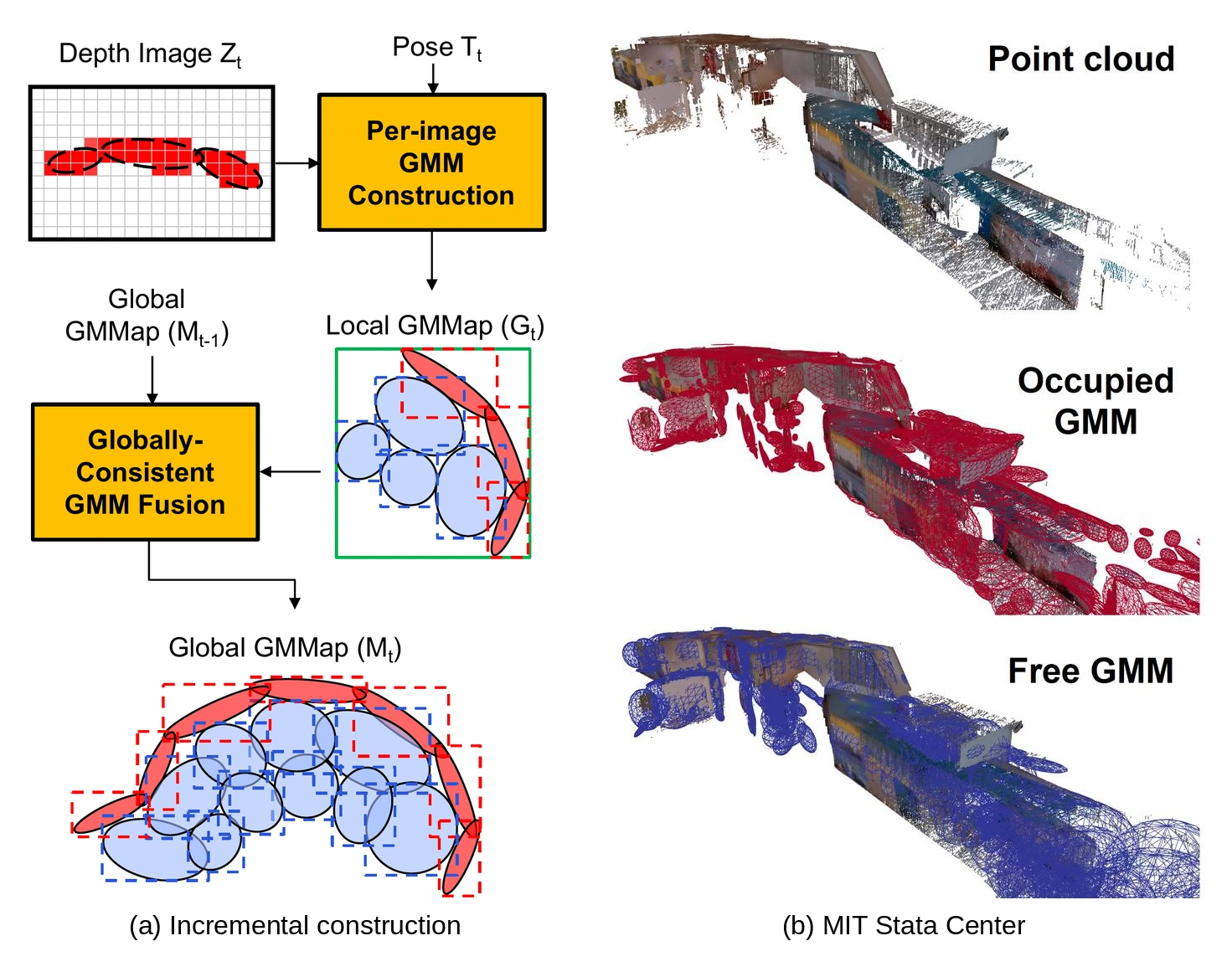
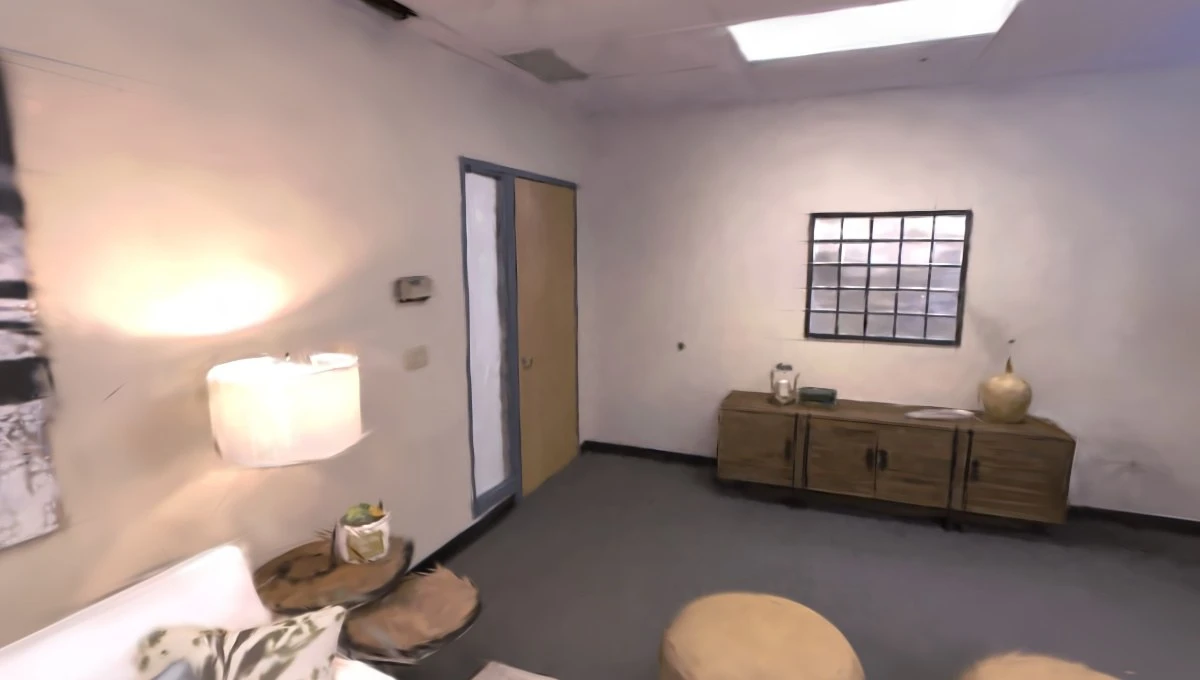
Gaussian representations can be substantially more compact to store than voxel maps at comparable fidelity. Their position, orientation, and extent adapt to observed geometry. For example, GMMap reduces map storage by at least 56% relative to the evaluated prior frameworks, while retaining comparable accuracy. GEVO also encodes appearance to regenerate camera views.
Algorithm
A compact map reduces storage, while construction and querying also determine memory requirements. SPGF constructs Gaussians in one pass over a depth image, without storing the image. GMMap fuses Gaussians directly and queries occupancy without converting them into points or voxels. GEVO retains the current image window and regenerates previous views, reducing storage of historical images.
Hardware
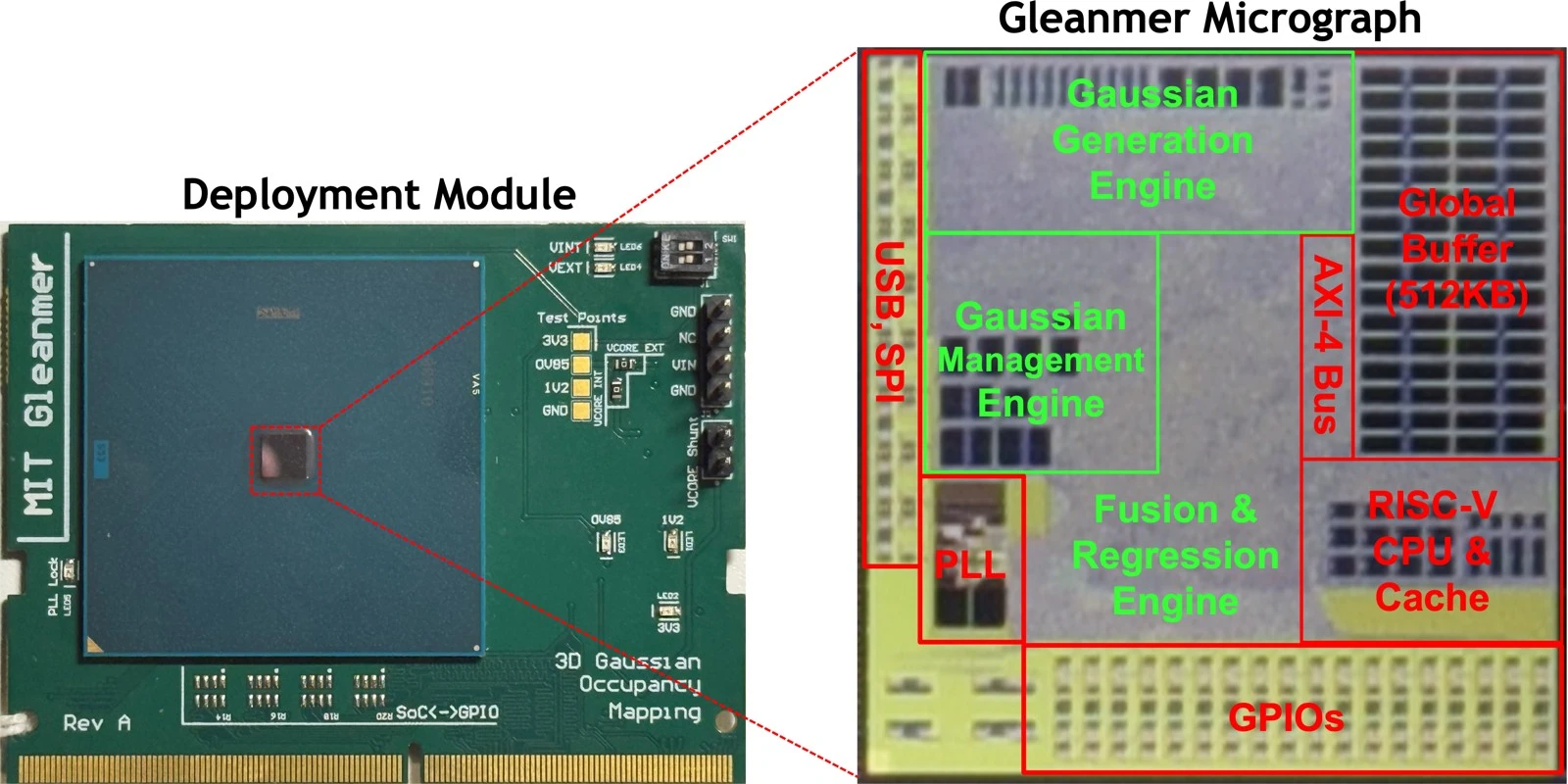
Gleanmer exploits correlations between occupied and free space, local Gaussian accesses, and different precision requirements in Gaussian arithmetic. These properties enable further energy savings beyond the compact map and its memory-efficient algorithms. The fabricated chip constructs and queries 3D occupancy maps under 6 mW of core power. The Shannon MI Accelerator co-designs occupancy-grid memory organization with parallel processing on a field-programmable gate array (FPGA).
Selected research
GMMap
GMMap represents obstacles, free space, and unexplored regions with compact Gaussians. One-pass construction and direct fusion reduce memory traffic.
- smaller maps than evaluated prior frameworks
- ≥56%
- less DRAM access in the comparison
- ≥78%
Gleanmer
Gleanmer constructs a 3D map of obstacles and free space on a fabricated chip using under 6 mW of core power. Its map and intermediate data remain in on-chip memory.
- core power
- <6 mW
- on-chip SRAM
- 622 KB
GEVO
GEVO estimates camera motion and reconstructs a scene while retaining fewer images in memory. It regenerates previous views from its map when they are needed.
- lower memory overhead than evaluated prior methods
- Up to 94×
- reported memory overhead
- ≈58 MB
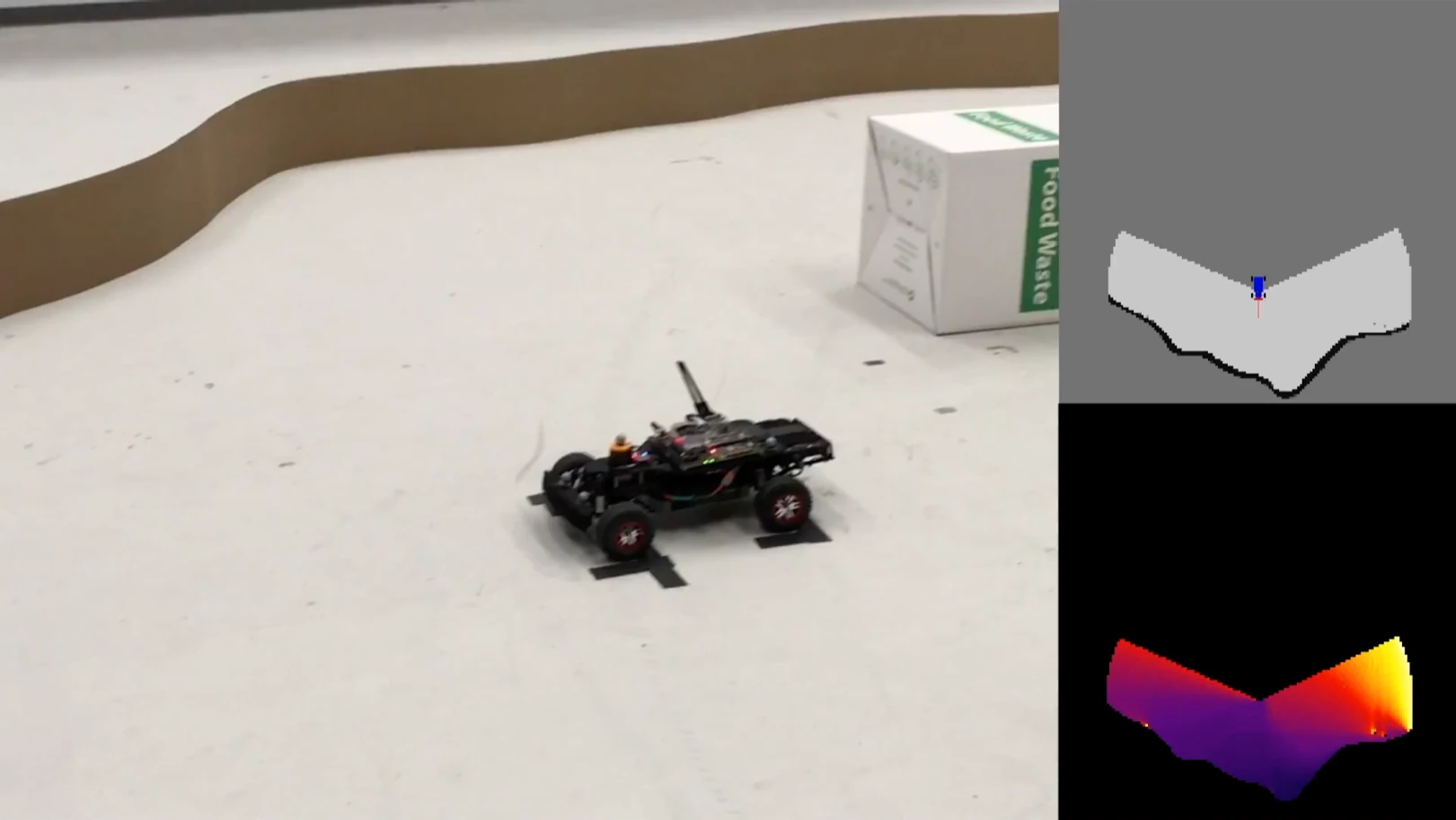
Shannon MI Accelerator
This FPGA evaluates sensor viewpoints by their expected reduction in map uncertainty. Co-designed memory and computation supply sixteen parallel cores with map data.
- faster MI evaluation vs. single-threaded Xeon
- ≈100×
- FPGA dynamic power
- ≈2 W
FUTURE RESEARCH
Representation co-design
across tasks and robots.
My future research will extend representation co-design from efficient computing within a robot to efficient communication across collaborating robots. I will investigate how spatial representations, algorithms, and specialized hardware jointly determine efficiency across these settings.
APPLICATIONS
Autonomy where resources
and communication are limited.
My proposed research connects energy-efficient onboard spatial intelligence with efficient communication, from remote habitats to everyday spaces.
Applications
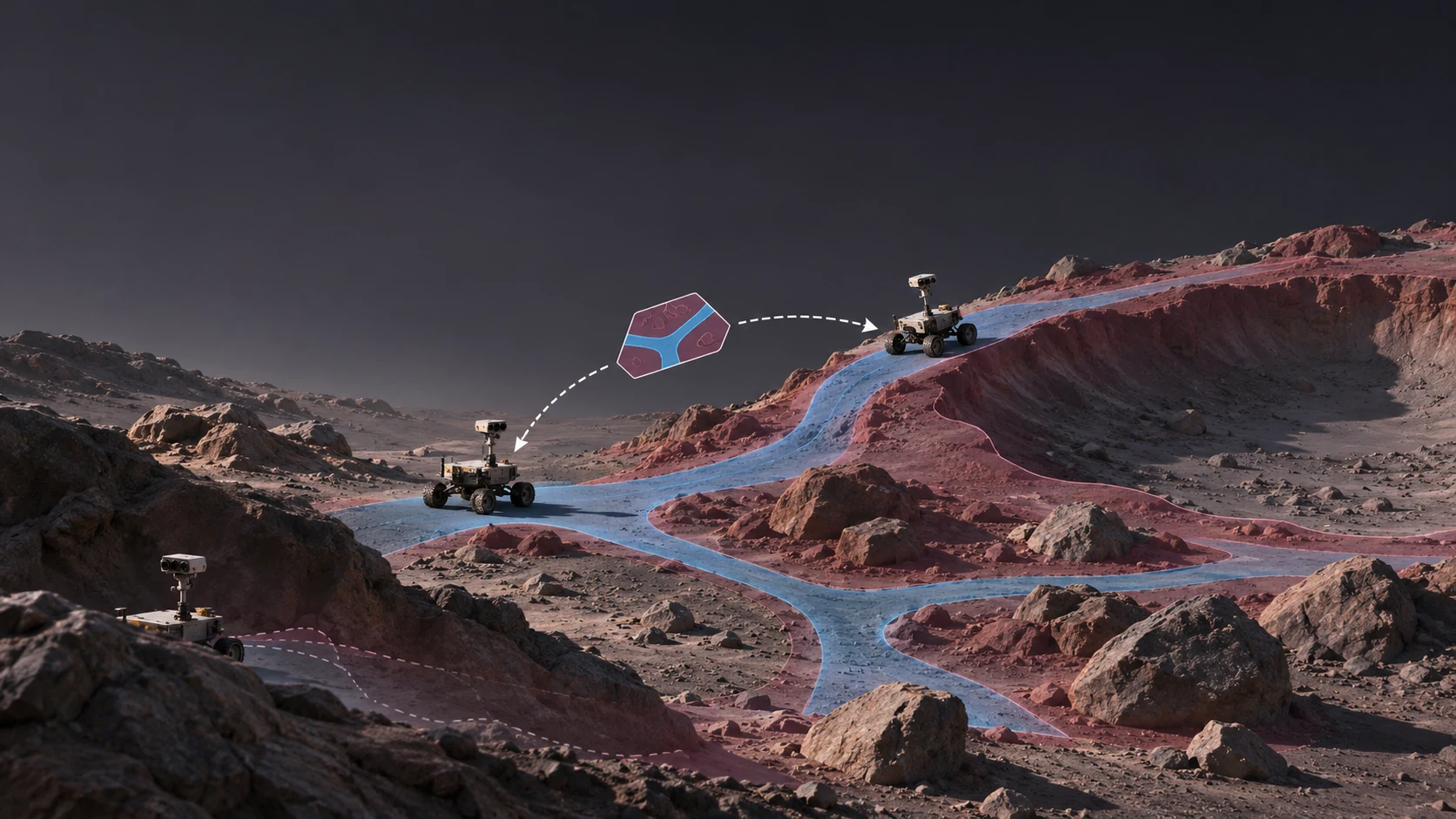
Cooperation without timely instructions from Earth
Small robot teams could explore different regions and share spatial information. Local autonomy must continue when communication with Earth is delayed.
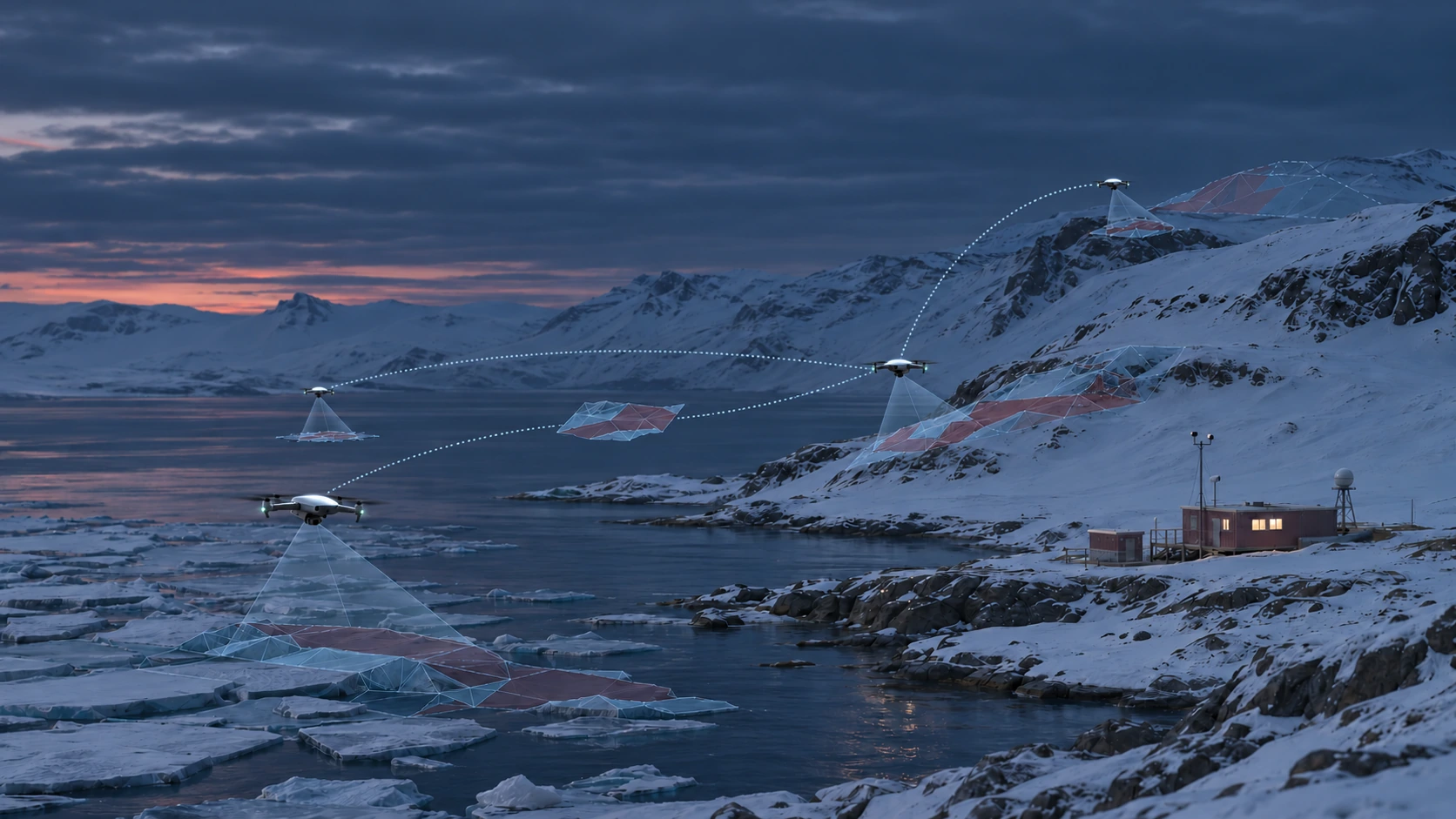
Longer observation missions over degraded links
Cold-limited batteries and unreliable radio links constrain Arctic monitoring. Efficient onboard computing and communication could support longer autonomous missions along remote coastlines.
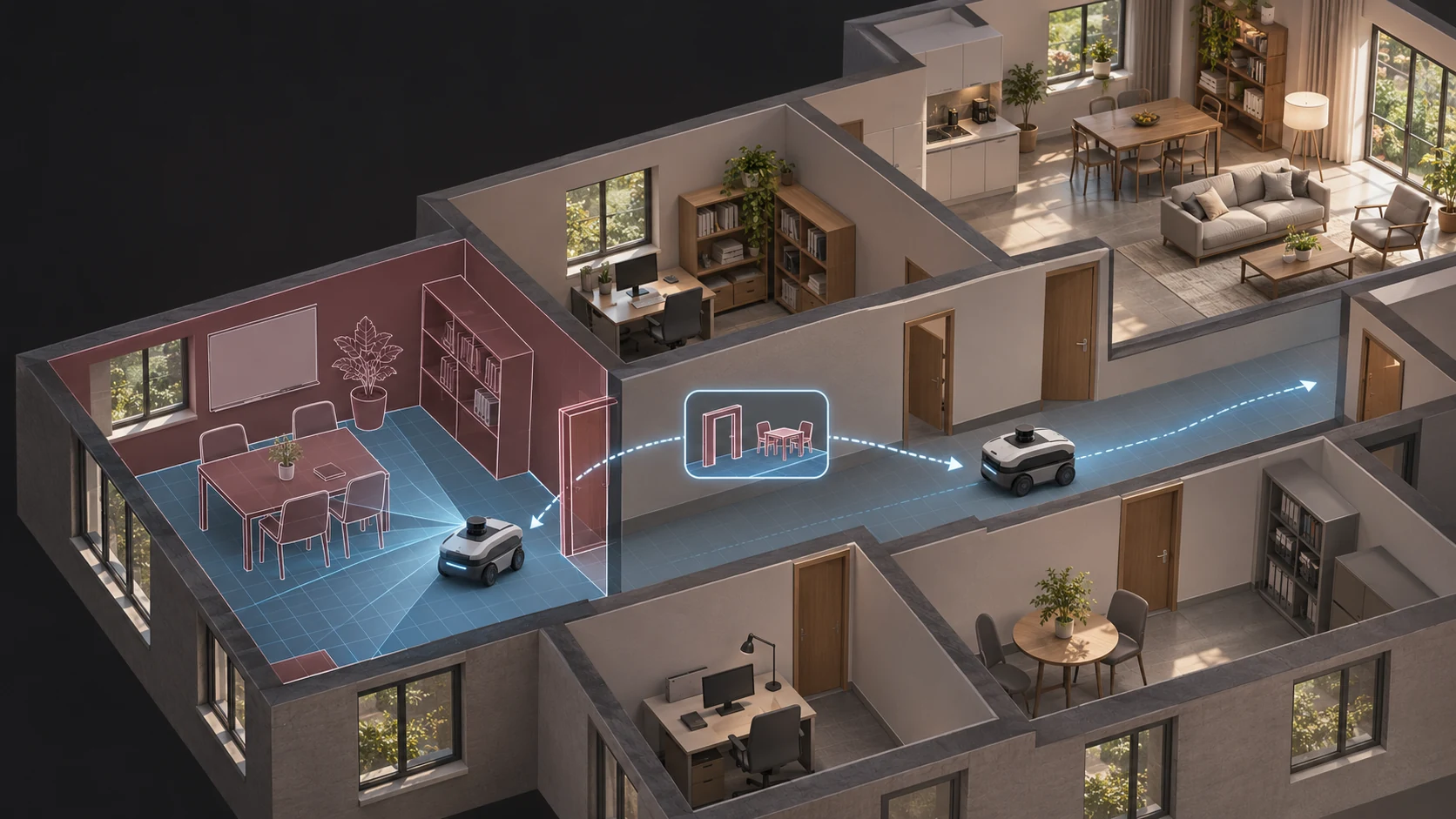
Onboard understanding in privacy-sensitive spaces
Robots could explore and inspect buildings while processing spatial information onboard. This could support autonomy with less transmission of images from private spaces.
Longer surveys with less disturbance
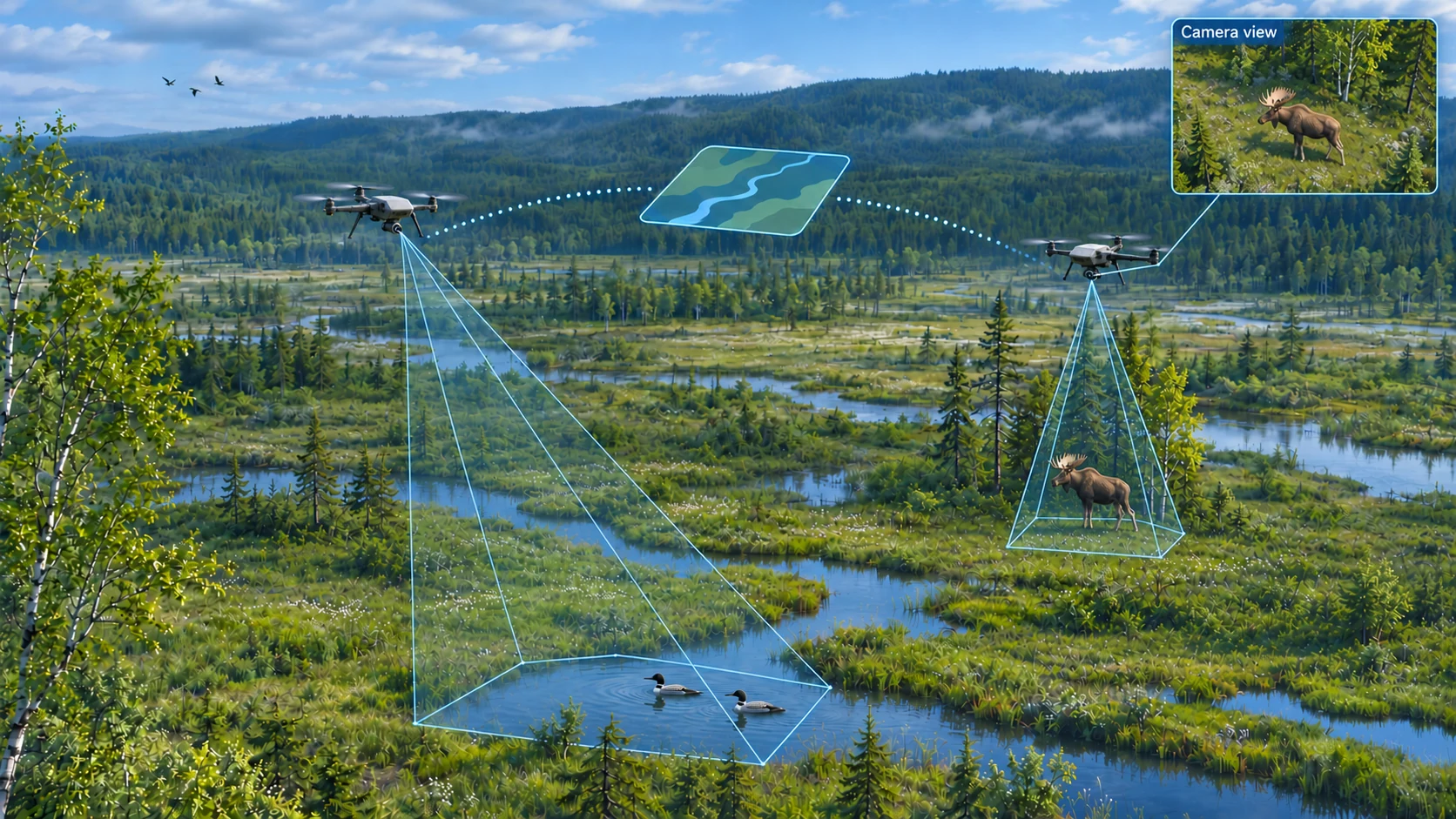
Teams could survey remote habitats while limiting computing and communication energy. Longer autonomous missions could extend coverage with less disturbance to wildlife.