Gleanmer receives the VLSI Best Demo Award.
A live demonstration of real-time Gaussian occupancy mapping in fabricated silicon, with Zih-Sing Fu and collaborators.
See the project
Energy-efficient spatial intelligence
through representation co-design.
MIT EECS PhD ’25 / Embedded Systems Engineer, Tycho AI
Image: Rover teams sharing maps on a planetary surface
RESEARCH VISION
A robot uses spatial models to locate itself, identify obstacles, and plan motion. Representation co-design widens algorithm–hardware co-design to include spatial representations shared across tasks and robots. These representations determine the structure and volume of the data robots store, process, and exchange. Redesigning them can reduce data movement, which can dominate computing energy.
My research extends representation co-design from efficient computing within a robot to efficient communication across collaborating robots.
Explore the research program DISCOVER THE WORK↓Selected research
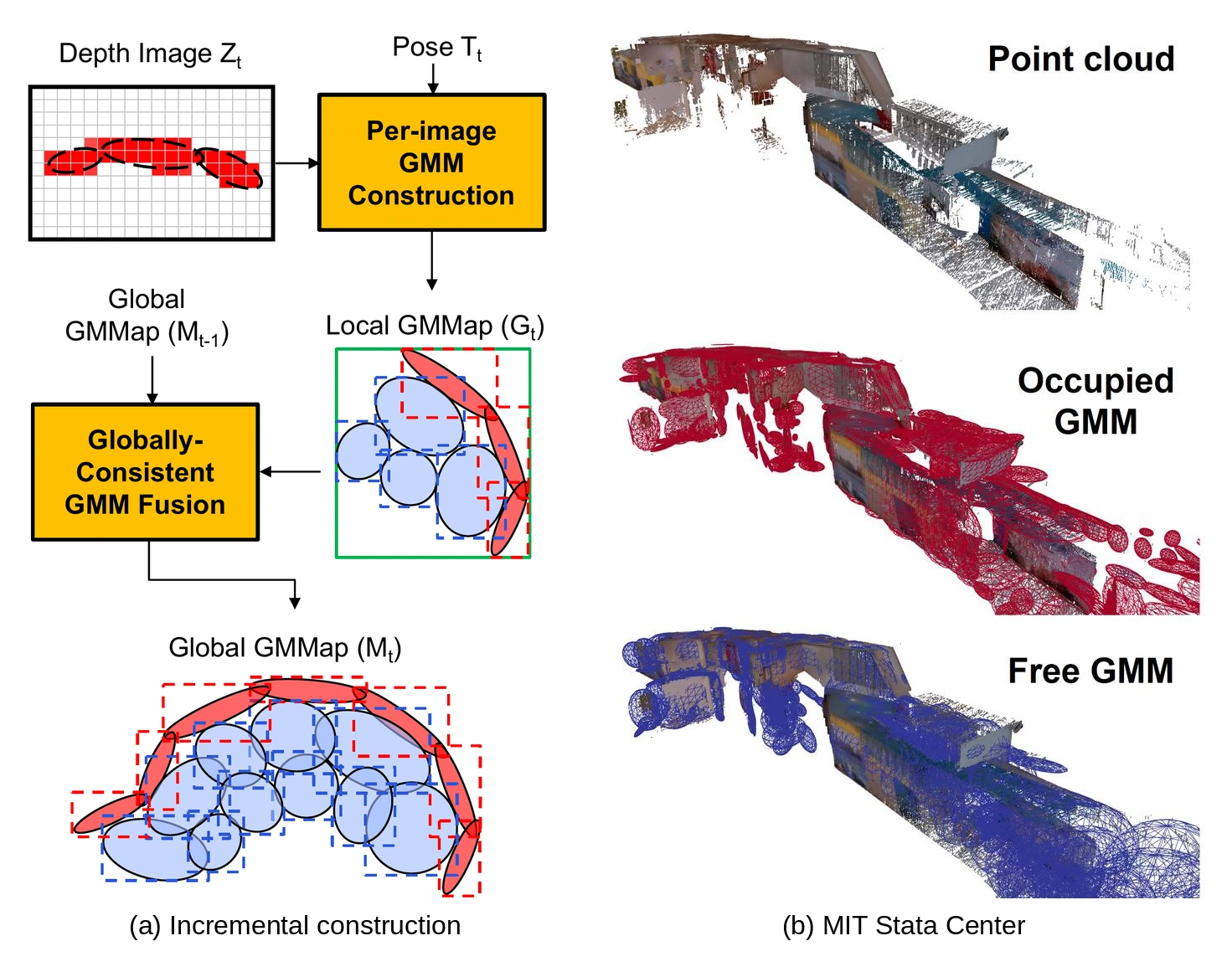
GMMap represents obstacles, free space, and unexplored regions with compact Gaussians. One-pass construction and direct fusion reduce memory traffic.
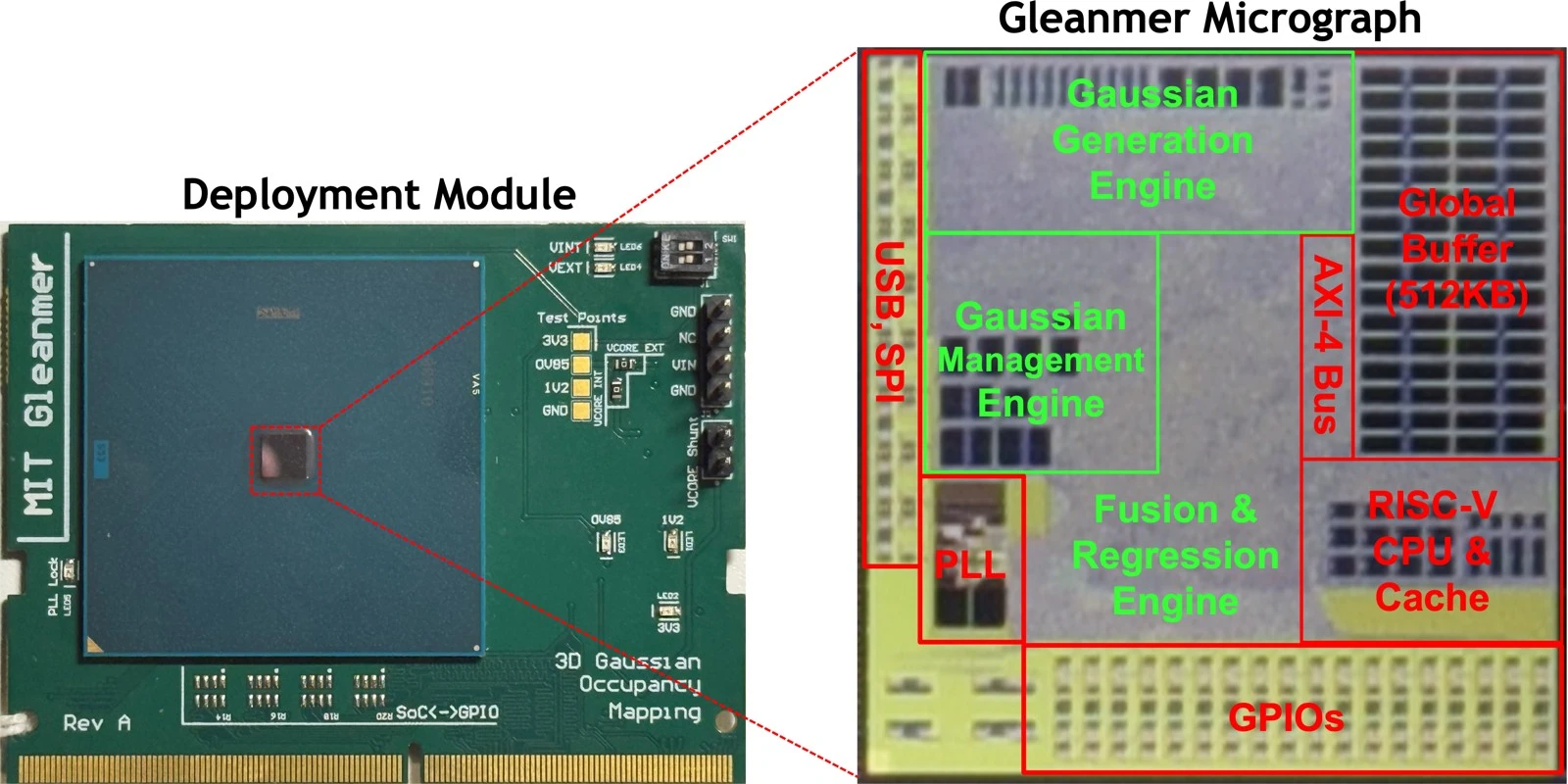
Gleanmer constructs a 3D map of obstacles and free space on a fabricated chip using under 6 mW of core power. Its map and intermediate data remain in on-chip memory.
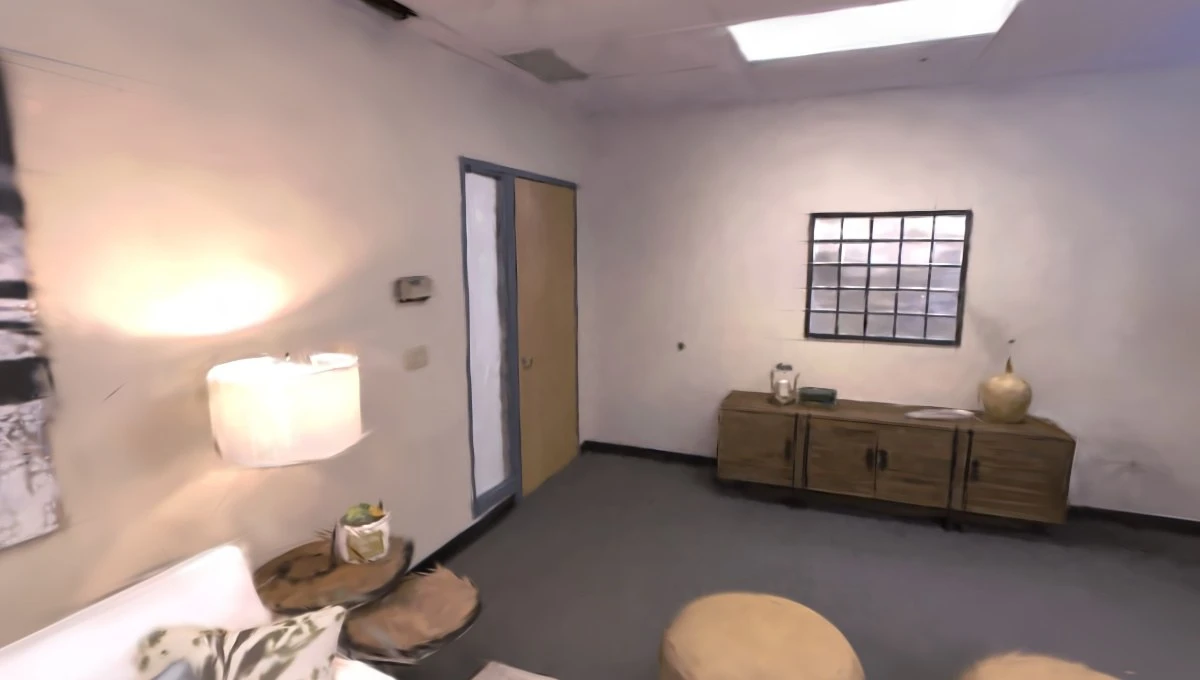
GEVO estimates camera motion and reconstructs a scene while retaining fewer images in memory. It regenerates previous views from its map when they are needed.
This FPGA evaluates sensor viewpoints by their expected reduction in map uncertainty. Co-designed memory and computation supply sixteen parallel cores with map data.
LIVE MAPPING DEMONSTRATION
Gleanmer implements GMMap on a system-on-chip (SoC), constructing 3D occupancy maps in real time under 6 mW of core power. At comparable map accuracy, our VLSI paper reports 44× lower power than the prior state-of-the-art mapping accelerator. It also reports at least 341× lower power than NVIDIA Jetson TX2 running GMMap.
SELECTED MILESTONES
A live demonstration of real-time Gaussian occupancy mapping in fabricated silicon, with Zih-Sing Fu and collaborators.
See the projectJoining the early-career research cohort at Robotics: Science and Systems.
View the 2026 cohortFinal-project tutorials and SystemVerilog recitations connect implementation steps to course concepts.
Teaching and mentoring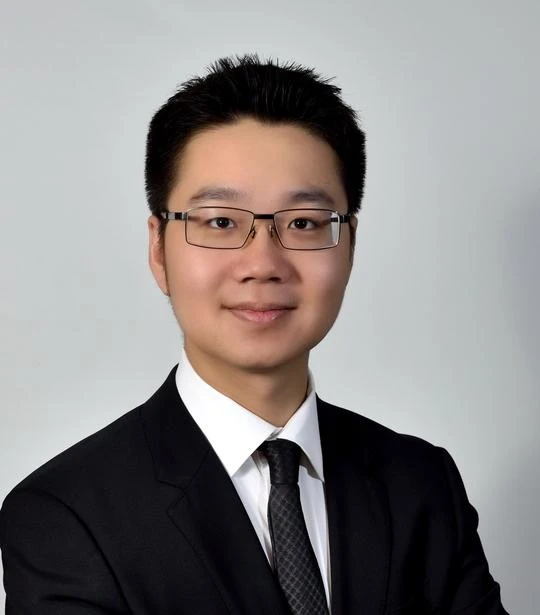
ABOUT ME
I am an embedded systems engineer at Tycho AI, where I lead the specialized hardware team. I received my PhD in Electrical Engineering and Computer Science from MIT in 2025, advised by Vivienne Sze and Sertac Karaman. My research centers on representation co-design: designing spatial representations, algorithms, and hardware together for energy-efficient robot autonomy. Recognition includes selection as an RSS Pioneer (2026), the VLSI Best Demo Award (2026), and graduate first place in the ACM SRC Grand Finals (2020).