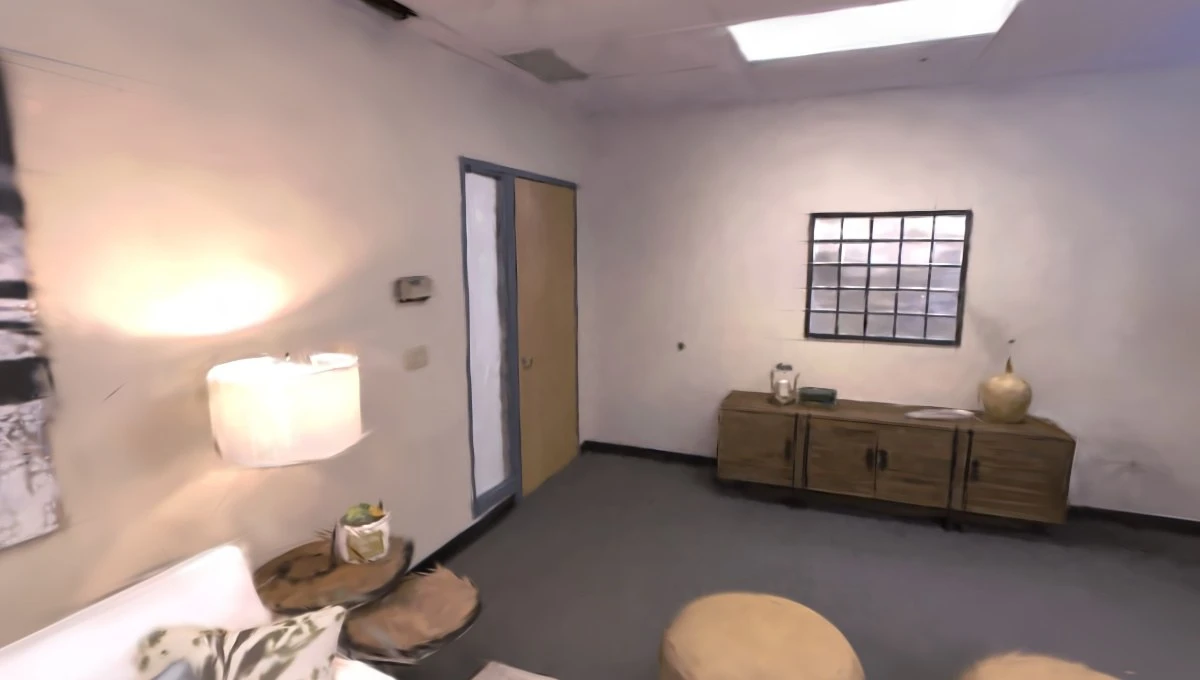
Reconstructing a scene within a limited memory budget
A moving camera can estimate its motion by comparing successive images. This process, called visual odometry, provides motion estimates for robot navigation. GEVO uses one color camera, an arrangement called monocular vision, to estimate motion and reconstruct the surrounding scene.
Small robots and augmented- or virtual-reality headsets motivate this problem. Their limited memory must support both motion estimation and a model of the surrounding environment.
To preserve previously mapped regions, many systems retain earlier camera images and reuse them during map refinement. Those images can require more memory than the map itself. GEVO retains images in the current sliding window and regenerates older views from its stored map when they are needed.
GEVO represents the scene with 3D Gaussian probability distributions, each with a location, spatial extent, and associated color information. Rendering these elements into an image is called Gaussian splatting. Dasong Gao and I contributed equally to GEVO, published in IEEE Robotics and Automation Letters in 2025. The paper evaluates the memory needed to maintain this photorealistic map.
Degradation of previously reconstructed regions
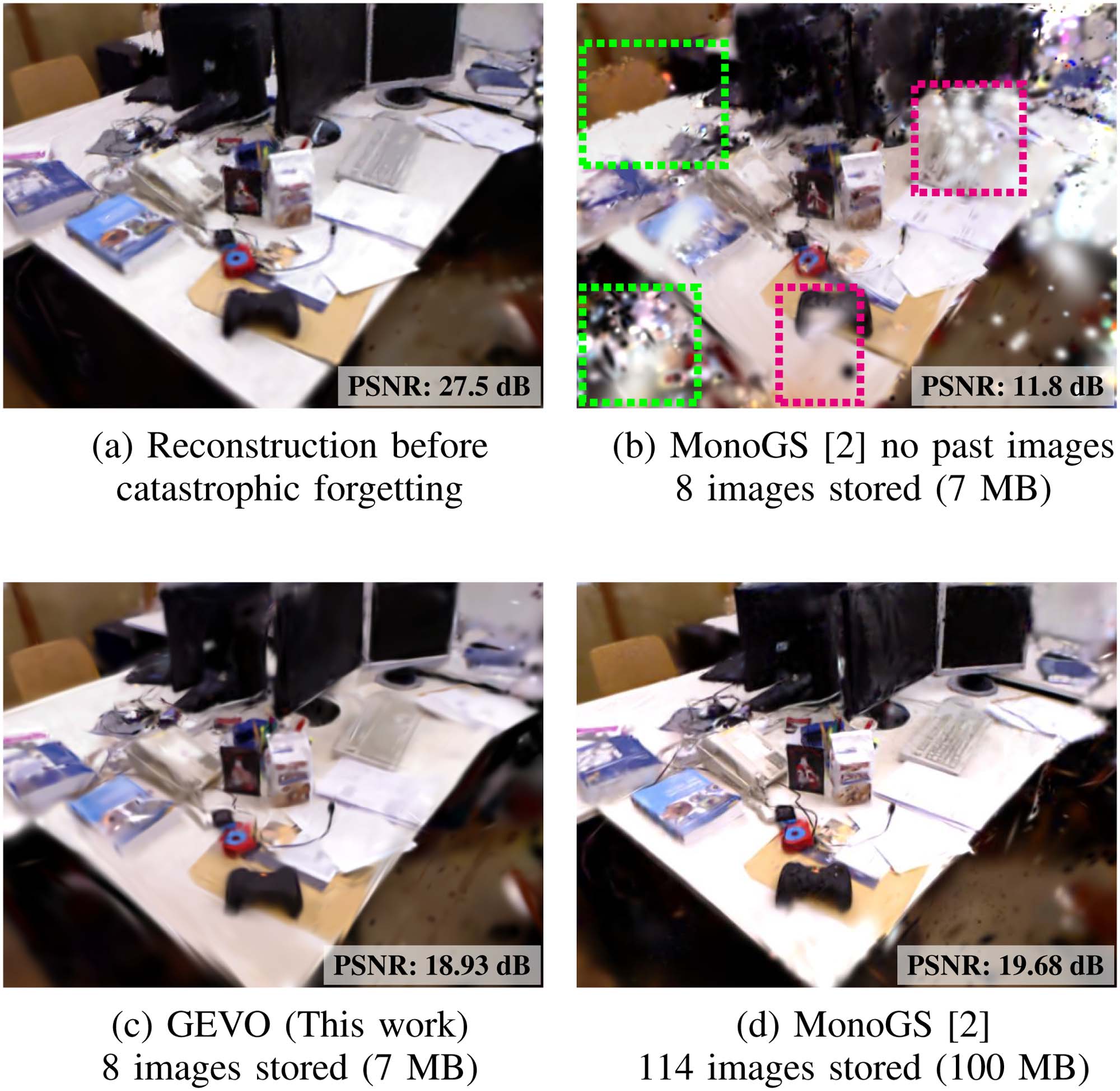
As a camera moves, the map is refined using recent images. Updates that improve recent reconstructions can reduce fidelity in previously mapped regions after their source images leave the current window. This loss of previously learned appearance is called catastrophic forgetting.
The published example below compares the same earlier view before and after further mapping. GEVO and the baseline without past-image replay retain eight current-window images. The comparison in panel (d) stores 114 images. These image counts and storage sizes describe this example. Peak signal-to-noise ratio (PSNR) measures rendered-image fidelity relative to a reference image. Higher values indicate a closer match.
Regenerating previous views from the map
GEVO renders selected earlier viewpoints from its existing map and uses those images as references during refinement. This replay replaces stored historical images with computation, reducing memory overhead.
The rendered references can contain reconstruction errors. Reusing these references during optimization can cause further degradation of map fidelity. Replay alone therefore does not prevent forgetting.
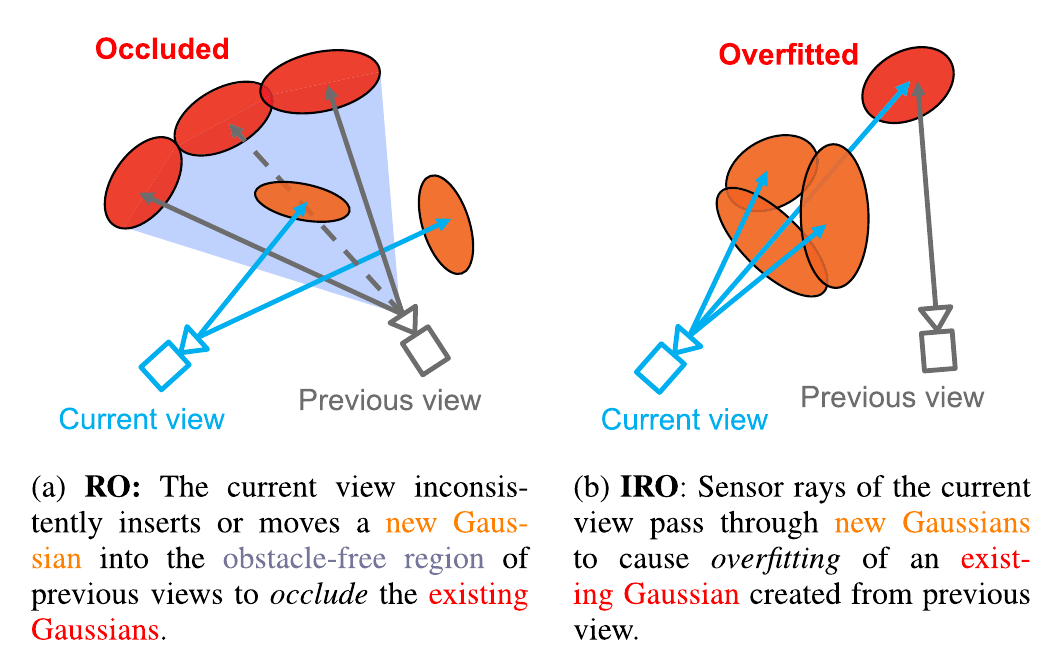
Two geometric mechanisms contribute to this degradation. New Gaussians can incorrectly occlude surfaces visible from earlier viewpoints. Incomplete occlusion can also cause previously mapped Gaussians to overfit the appearance in current images.
Preserving free space and constraining map updates
An occupancy map records obstacles, observed free space, and unexplored regions. I introduced GEVO’s occupancy-preserving initialization, adapting the Gaussian fitting approach underlying GMMap to initialize both obstacles and free space. The free-space information helps identify and remove Gaussians that would incorrectly obstruct earlier views.
GEVO also refines newly initialized Gaussians locally before merging them into the global map. Global refinement updates the new local map and selected existing Gaussians with high rendering error, rather than every map element. Regenerated earlier views provide an additional consistency constraint during this update.
Together, occupancy-preserving initialization, selective optimization, and replay reduce degradation in the regenerated views. This is representation–algorithm co-design under GPU memory constraints: geometric free-space information changes how the photorealistic map is initialized and refined. Regenerating references from the map then reduces storage of historical images. A small final map alone does not establish low construction memory or energy.
Results and scope
Across the environments evaluated in the paper, GEVO maintains map fidelity comparable to the prior methods in the comparison. Its reported memory overhead is approximately 58 MB, up to 94 times lower than those methods. This memory overhead figure does not describe total system memory.
Visual comparison of reconstructed scenes
The views below illustrate how GEVO retains scene appearance while storing fewer earlier images. They include synthetic Replica scenes in the top row and real TUM RGB-D camera images below.
The first five columns compare reconstructions from prior methods and two GEVO variants; the last column shows the ground-truth image. The “Ours” columns use direct tracking and ORB-SLAM tracking.
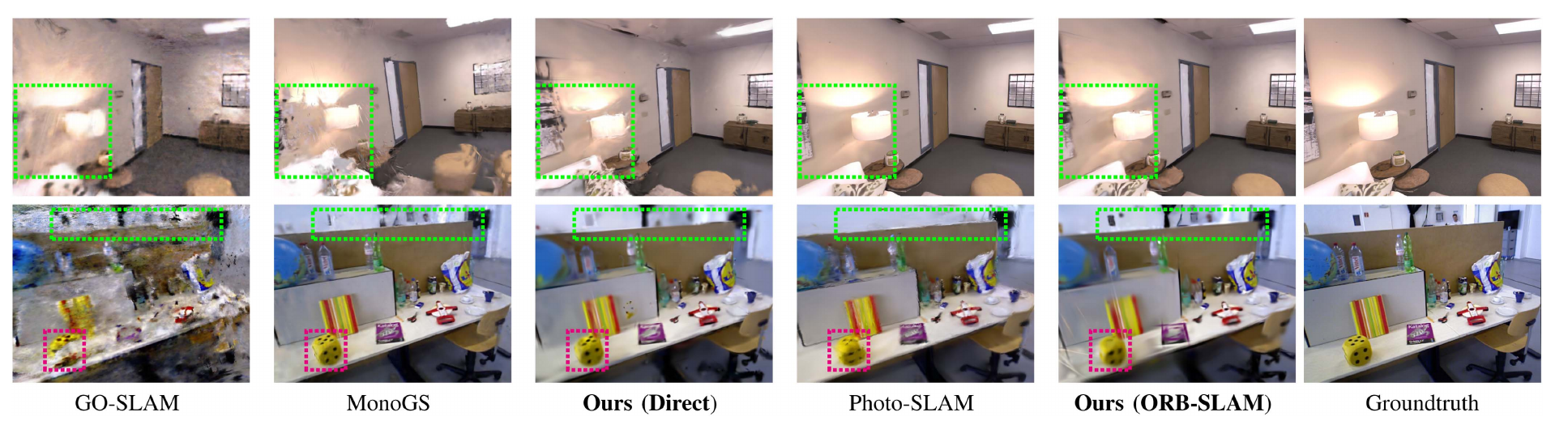
The paper attributes GEVO’s preservation of large or distant structures to the free-space constraints that reduce incorrect occlusions. Fine details can still degrade as imperfect rendered references are reused. GEVO with ORB-SLAM tracking has lower PSNR than Photo-SLAM in the evaluation, reflecting this memory–fidelity trade-off.
Isolating the effect of map refinement
The ablation study examines this trade-off by isolating map refinement from motion-estimation error. It averages rendering fidelity over keyframes from three TUM RGB-D sequences, using ground-truth camera trajectories.
With all techniques, final fidelity reaches 19.0 dB PSNR, compared with 19.4 dB when original past images are stored and replayed. Without past-view retraining, it reaches 15.5 dB. These benchmark averages differ from the single-view example above.
GEVO is also distinct from Gleanmer. Gleanmer is fabricated hardware for Gaussian occupancy mapping. GEVO is a monocular visual-odometry and photorealistic-mapping framework. Its paper discusses opportunities for future acceleration, rather than reporting that GEVO itself runs on the Gleanmer chip.
The project repository provides the paper, project description, and a code-release notice. The repository records the status of the implementation code release.
Cite this work
GEVO: Memory-Efficient Monocular Visual Odometry Using Gaussians
BibTeX
@article{gao2025gevo,
  author = {Gao, Dasong and Li, Peter Zhi Xuan and Sze, Vivienne and Karaman, Sertac},
  title = {{GEVO}: Memory-Efficient Monocular Visual Odometry Using Gaussians},
  journal = {IEEE Robotics and Automation Letters},
  volume = {10}, number = {3}, pages = {2774--2781},
  year = {2025},
  doi = {10.1109/LRA.2025.3534683},
  note = {First two authors contributed equally}
}Related research